There are more than six thousand languages in use. Over 400 of those languages have full translations of the Bible; over 1000 have the New Testament, and many more have at least some portion of the Bible.
In terms of language learning: if you're learning a language, you can probably find a copy of the Bible in both it and your native language. It'll help if you're familiar with the Bible, but even if you aren't it's a good reading exercise.
When I started French, I found my mom's copy of the French Bible; I made it my goal to read a bit every night, whether I understood it or not. And you know what? It really helped my reading comprehension, and quite possibly my pronunciation, too. I've been doing the same thing with Arabic, and while it's been slow going (even with pronunciation help), I know it's been good for me.
And if there isn't a translation? Wycliffe Bible Translators plans to have a project in every language that needs it by 2025. And yes, there are translations in Klingon and Esperanto.
Main source: http://www.wycliffe.org/about/statistics.aspx
Showing posts with label tools of language learning. Show all posts
Showing posts with label tools of language learning. Show all posts
October 31, 2010

October 4, 2010
Tools of Language Learning: the Dictionary
It may seem obvious, but it's worth a mention: a dictionary can be quite important when learning another language, especially for higher-level and more motivated learners.
Many textbooks have rudimentary dictionaries in the back; other times you'll have to buy your own. If you're serious about a language, you should probably get one. Using one helped my French in high school, helps my comprehension of French literature now, and helps me in everything in Arabic.
There are several different types of dictionaries, each with different uses:
English-Arabic*: Look up a word in your native language, find it in the language you want to use it in. This type of dictionary is particularly useful when you don't know how to say something in your target language. Some have phrases and expressions, and most should have pronunciation guides. Be careful, though--knowing the word is not the same as knowing how to use it. You might also get the wrong word; I've heard of some amusing confusions of "public" and "pubic."
Arabic-English: This comes in handy for reading or listening comprehension, but be aware: languages are not the same. English, and European languages in general, are in alphabetical order. Arabic is, too, but it alphabetizes by roots so, for example, "kitaab" and "maktaba" are in the same entry (their root is k-t-b). The Chinese dictionary--well, my sources (Wikipedia) claim some have been organized by subject, others by stroke numbers, and others by phonetics. If you're in a language class, they'll teach you how to use a dictionary, usually about the same time you have to pay $40 for it.
Arabic-Arabic: The words and definitions are in the target language. This won't be much help to a beginner, but an advanced learner may find it helpful to learn a word's meaning in its original language. It's harder, but can definitely be worth it. But just because it builds character/comprehension doesn't always make it fun--
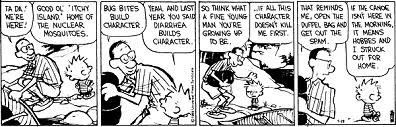
(with all due credit to Bill Watterson)
*I use this as the example because it's the one on the shelf above my desk. Assume English as the native language, Arabic as the language being learned.
Many textbooks have rudimentary dictionaries in the back; other times you'll have to buy your own. If you're serious about a language, you should probably get one. Using one helped my French in high school, helps my comprehension of French literature now, and helps me in everything in Arabic.
There are several different types of dictionaries, each with different uses:
English-Arabic*: Look up a word in your native language, find it in the language you want to use it in. This type of dictionary is particularly useful when you don't know how to say something in your target language. Some have phrases and expressions, and most should have pronunciation guides. Be careful, though--knowing the word is not the same as knowing how to use it. You might also get the wrong word; I've heard of some amusing confusions of "public" and "pubic."
Arabic-English: This comes in handy for reading or listening comprehension, but be aware: languages are not the same. English, and European languages in general, are in alphabetical order. Arabic is, too, but it alphabetizes by roots so, for example, "kitaab" and "maktaba" are in the same entry (their root is k-t-b). The Chinese dictionary--well, my sources (Wikipedia) claim some have been organized by subject, others by stroke numbers, and others by phonetics. If you're in a language class, they'll teach you how to use a dictionary, usually about the same time you have to pay $40 for it.
Arabic-Arabic: The words and definitions are in the target language. This won't be much help to a beginner, but an advanced learner may find it helpful to learn a word's meaning in its original language. It's harder, but can definitely be worth it. But just because it builds character/comprehension doesn't always make it fun--

(with all due credit to Bill Watterson)
*I use this as the example because it's the one on the shelf above my desk. Assume English as the native language, Arabic as the language being learned.
Subscribe to:
Posts (Atom)

 Posts
Posts

